
I have lived in and around the Southampton area for most of the past 30 years and throughout that time I have been a regular user of Southampton Airport.
It’s a superb regional airport and offers a range of local and European destinations which work well for business and personal travel alike. It’s rarely busy in the same sense as the large airports and, in fact, I consider a recent trip (well pre-Covid) in which I made it from my bed to the departure gate for the red eye to Edinburgh in less than 35 mins one of my more significant lesser achievements!
In addition to serving the local community the presence of the airport makes a significant contribution to the local economy. In particular, the Port of Southampton has five cruise ship terminals which serve destinations worldwide. That alone could allow up to 20,000 visitors per day to pass through the city, many of them travelling by air.
The airport does, however, have one major drawback, which is the length of its runway. It is constrained at one end by Eastleigh Railway Works and at the other by the M27 motorway. Aircraft take off and land into the wind and the prevailing wind in this part of the country is south-westerly, meaning the majority of take-offs occur on Runway 20 over the M27 and the city of Southampton. A further complication is the presence of the Townhill Park and Bitterne Park areas of Southampton, which are less than a kilometre from the end of the runway and elevated significantly above it. These two constraints (runway length and the elevated areas of Southampton) limit the type of aircraft that are able to use the airport and, historically, it has primarily been used by smaller turboprop aeroplanes and a handful of smaller jets. Some larger jets (such as the Airbus A319/320 and Boing 737) do use the airport (infrequently) but they are unable to travel to destinations within their full range because the above constraints limit their take-off weight.
The airport’s response to this was to apply for planning consent to extend the runway by 164 m at the northern (Eastleigh) end of the site. This extra length, they said, would enable the larger jets to take off from the airport with a greater fuel load and hence able to reach more distant destinations. This in turn would attract new carriers with new destinations which ultimately would secure the viability of the airport into the future.
One of the thorns in the tail of this plan, however, was the extent of the noise impact from the operation of the airport, particularly over the city of Southampton (as the majority of departing aircraft take off and then fly over a densely populated area of the city). There were other impacts too which included air quality issues and the loss of some historic woodland, but, given the nature of this blog, I’m just focusing on the noise aspects!
Although Southampton City Council was not the decision-maker they are in the unfortunate position of bearing the brunt of the environmental impact of the airport’s operations. As a result they were fully consulted throughout the process by Eastleigh Borough Council and I was employed by Southampton City Council to review the noise impact assessments undertaken in support of the planning application on behalf of the airport.
I ended up producing three technical reports over the course of this work as the planning application became prolonged, both as a result of the Covid-19 outbreak and also due to the fact that the airport was required to reconsider their proposals and reassess the noise impact during the course of the application (there were also a few technical errors made by the multinational company that undertook the noise impact assessment which we asked to be put right too 😉).
At the outset the airport’s own consultants advised that the noise impact of the proposals would result in ‘direct long-term adverse effect of major significance prior to mitigation’ and it was established that an additional 6,300 households would be subject to a daily adverse or significant adverse noise level from aircraft movements (again to prior mitigation).
So clearly perhaps the airport was in an impossible position. They made strong representations that the future of the airport would be at risk without the runway extension whilst at the same time admitting that the noise impact from its operation would be of major significance. Their way through this was to offer both a limit on passenger numbers and effectively a noise limit (way more than this in practice but complex and tricky to explain easily in laypersons’ terms) together with noise insulation for eligible properties.
I’ve never been comfortable with the concept of noise insulation to provide the worst affected residents with protection from aircraft noise for a number of reasons. 1. It only protects the inside of the properties, external amenity spaces; gardens, patios, balconies etc. are unprotected and 2. It can lead to ventilation and overheating issues as windows need to be kept closed at all times and hence an uncomfortable internal environment if these matters are not also addressed. However, it is a very common means of mitigation provided by airports to local residents.
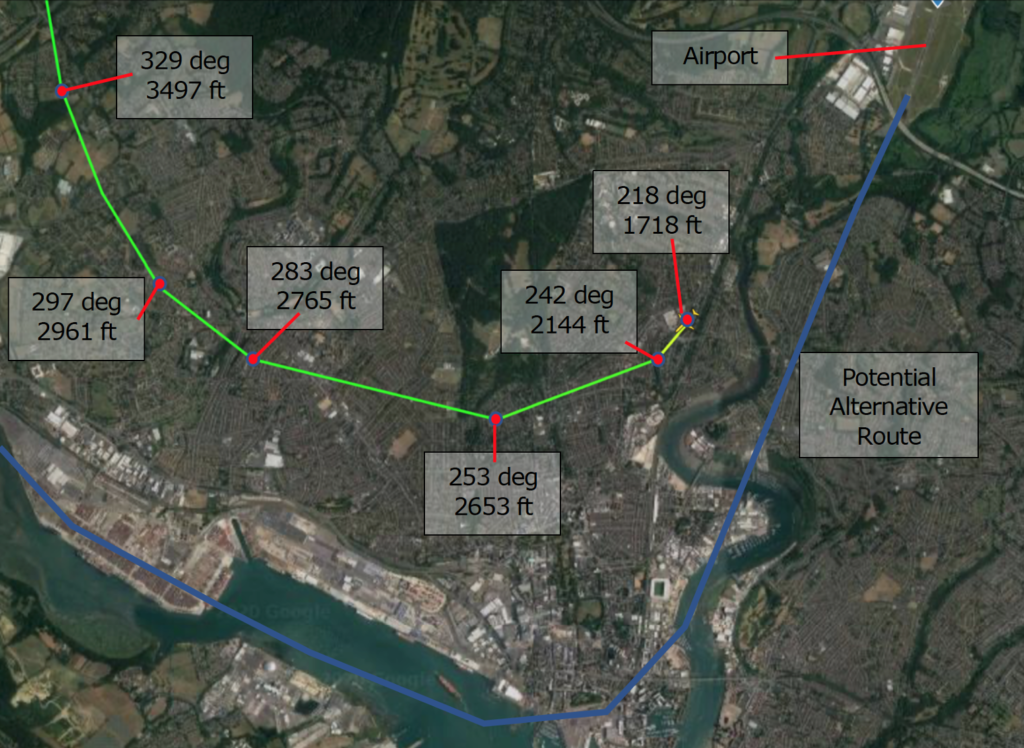
One further mitigation measure, which the airport was unable to consider for reasons detailed below, is that of changes to flight departure routes, particularly for southerly departures over Southampton. Current procedures dictate that aircraft taking off on Runway 20 climb straight ahead to 500 ft, then turn right to a heading of 217 degrees which ‘directs aircraft towards the path of the River Itchen’ (note- it doesn’t really- the river is very meandering!). This track is maintained until reaching an altitude of 2,000 ft or until reaching Southampton Water, whichever occurs first, at which point the aircraft may change course as required. The exact point at which aircraft reach 2,000 ft and subsequently turn will vary depending on many factors including engine type, aircraft weight and weather conditions. You probably don’t need to be a rocket scientist, an aircraft engineer, a pilot or even an acoustic engineer to appreciate that the larger and faster jets that the extended runway was being designed to facilitate will have greater capability to reach that altitude earlier (than the turboprops primarily used by the airport) and hence turn way before Southampton Water and fly over the most densely populated areas of the city. So bigger planes and more of them, flying more frequently directly over the top of local residents. Quite an ask really!
In the course of my work for Southampton City Council I emphasised that I felt that consideration could be given to revision of this procedure. This could have included a power reduction at a defined altitude from take-off power to climb power (as is in place at Heathrow for example) and, potentially of greater significance, continuation of the 217 degree heading with no turn permitted until Southampton Water is reached.
I was able to witness the significance of the airport’s departure tracks first hand as a passenger in a flight from Southampton to Newcastle in November 2020, flying in an Embraer ERJ135 which is a small twin-jet-engined aircraft with a passenger capacity of 37. I observed as we turned very early after taking off and flew over Swaythling, Portswood, Highfield, Lordswood and Millbrook, which are all heavily populated areas of the city. I downloaded the route from FlightRadar 24 and overlaid it with a potential alternative (although I accept that the right hand turn I’ve shown- in blue below- might be a bit of a handbraker- but I think it illustrates my point- my route would overfly far fewer dwellings).
Sadly the airport’s, response to this was that changes such as this are outside of their direct control and can only be designed and approved through an Airspace Change Proposal (ACP) which is planned at the airport later this decade. They did, however, commit to ensuring that such measures are explored at that time.
After a very lengthy planning application process Eastleigh Borough Council finally granted planning consent for the runway extension in April 2021. This was subsequently unsuccessfully challenged via judicial review in the High Court by a group of residents. The judge’s ruling was published on 23 May this year and I suppose until that point the future of the proposed runway extension (and potentially the airport as a whole) remained uncertain.
The airport is now finally able to commence works if they so choose. When the idea for the runway extension was first conceived cynics might say that the airport was perhaps seeking to capitalise on the demand for ‘cheap’ flights (not entirely true in my opinion). Having gone through the agony of finally gaining a planning consent and seeing off a judicial review, a process which in total has taken the best part of 4 years, the irony might be that, post-pandemic, in the midst of very severe increases in fuel prices together with a cost of living squeeze, perhaps both the availability of ‘cheap’ flights and the demand for them have waned away. In the meantime the airport continues to operate, serving the population of Southampton and its surrounds extremely well, but it does create a degree of noise impact, even without the runway extension.
Whether the runway extension is justifiable or not given the further benefits it will ultimately provide to the city simply depends on which side of the fence you choose to sit on. My opinion? Please don’t ask. I’ve built a very comfortable armchair right on top of it!
A copy of my first report for Southampton City Council is available here:
https://www.southampton.gov.uk/modernGov/documents/s43587/Appendix%201.pdf
Reuben Peckham
11 December 2024 at 08:30
As a fellow enthusiast, I really enjoy the unique perspective you bring to the table.
It is refreshing to find out things from a different angle.